

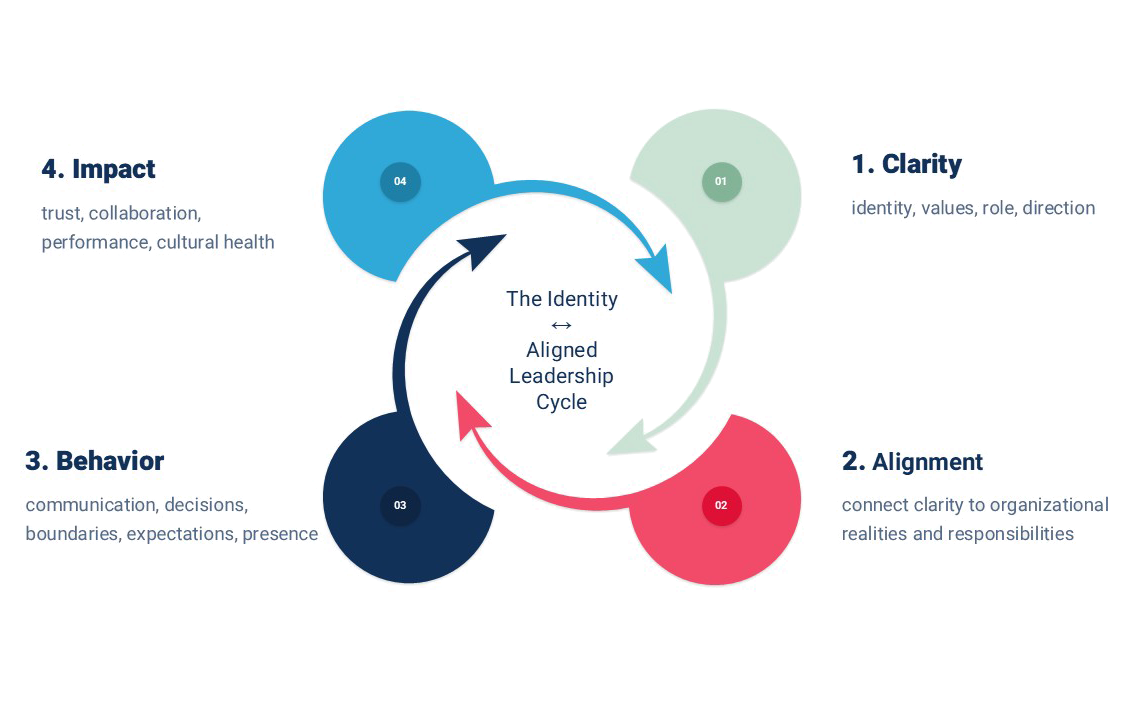
The Identity ↔ Aligned Leadership Cycle

Framework

The Identity-Aligned Leadership Cycle diagram: Clarity, Alignment, Behavior, Impact

The Identity ↔ Aligned Leadership Cycle

When role identity and leadership behavior are aligned, clarity, authority, and ownership become natural – and teams execute without constant firefighting.

1

Clarity – Identity, Values, Role, Direction

Effective leadership begins with clarity about who you are in the role and what you stand for. This isn’t abstract self-reflection – it’s a grounded understanding of your role boundaries, core standards, responsibilities, and strategic direction.

Without clarity, leaders operate reactively. They try to imitate someone else’s management style instead of leading as themselves. They second-guess decisions, communicate inconsistently – and their teams feel it immediately.

Key Questions

  • Who am I as a leader in this role?
  • Which standards and values are non-negotiable for me?
  • What is my role – and what belongs on my team’s plate, not mine?
  • Where am I taking this team or unit?

2

Alignment – Connect Clarity to Organizational Realities

Once clarity exists, it must be connected to the expectations, interfaces, and pressures of your organizational environment. This is where internal standards meet business reality.

How do my values and standards translate into how I make decisions and lead my team under pressure and against organizational targets?

Key Questions

  • How does my leadership approach fit this organization’s reality?
  • What does effective leadership require at this specific stage?
  • Where do I adapt without compromising my core standards?
  • What expectations must I set or reset with peers, direct reports, and my manager?

3

Behavior – Communication, Decisions, Boundaries, Presence

When clarity and alignment are strong, leadership behavior becomes consistent and grounded. You communicate with conviction. Decisions hold. Boundaries become clear and manageable.

This is where leadership becomes visible and tangible to your team in every meeting.

Key Questions

  • How do I communicate expectations, delegation, and feedback?
  • What decision-making patterns do I model under pressure?
  • Where do I hold boundaries, and where do I flex?
  • What presence do I bring into the room?

4

Impact – Trust, Collaboration, Performance, Culture

Consistent, aligned leadership behavior creates measurable impact: teams take ownership, cross-unit friction drops, execution stabilizes, and trust strengthens.

Key Questions

  • Do people trust my consistency and follow-through?
  • Are cross-functional handoffs moving smoothly?
  • Are we executing with clarity and clear ownership?
  • Is the team operating proactively rather than waiting for instructions?

Why This Works Differently (The Continuous Loop in Organizations)

Most leadership programs deliver a burst of motivation or a list of tools that fades within two weeks. This model works in reverse: it builds a continuous loop where internal clarity becomes consistent behavior on the ground. Inside organizations, we embed this loop through live practice between sessions – defining 2–3 behavioral metrics upfront and measuring progress at 30, 60, and 90 days, so that Stage 4 (Impact) isn’t left as a vague feeling, but presented to leadership in clear data.

Accessibility Toolbar

The Identity Aligned Leadership Cycle Framework