

Does Executive Coaching Really Work? Proven Results in the Field
October 01, 2026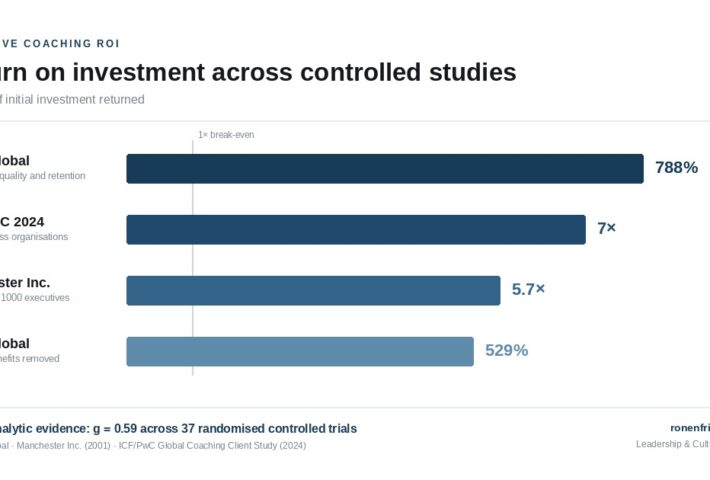
By Ronen Frieman | Leadership & Culture Strategist
Yes and the evidence is now strong enough that the interesting question has changed. Across 37 randomised controlled trials, executive coaching produces a statistically significant effect of g = 0.59 on leadership and personal outcomes. Controlled corporate studies record returns between 529% and 788%. Named organisations have published field results: coached employees at Twilio were 5× less likely to leave, and sales teams under coached managers hit 1.6× their quota attainment. The real question is no longer whether coaching works, but which conditions separate the engagements that produce these numbers from the ones that produce a pleasant conversation and nothing else.
This article sets out the field evidence: the meta-analytic effect sizes, the ROI studies, the named company results, and just as importantly the boundary conditions where the research shows coaching performing worse. For a plain-language explanation of the mechanism and when to engage a coach, see does executive coaching actually work. This piece is the evidence dossier underneath it.
What the meta-analyses actually measure
Survey satisfaction data is weak evidence. People like their coach. That tells you very little. The defensible evidence comes from meta-analyses that pool effect sizes across studies, usually reported as Hedges’ g or Cohen’s d. In organisational psychology, 0.2 is a small effect, 0.5 is moderate, and 0.8 is large.
Theeboom, Beersma and Van Vianen (2014) is the study that moved coaching from consulting opinion into evidence-based psychology. Pooling 18 coaching outcome studies (N = 3,100), it assessed five distinct individual-level outcome categories and returned significant positive effects on performance and skills, well-being, work attitudes, goal-directed self-regulation, and coping.
The effects ranged from g = 0.43 at the lower bound to g = 0.74 at the upper bound:
- Goal-directed self-regulation (g = 0.74) the largest effect in the analysis. The capacity to set, regulate, and relentlessly pursue complex organizational goals. This single finding explains why coached managers hit targets and project deadlines at materially higher rates.
- Coping (g = 0.43) the lower bound of the variables studied. Even here, coaching produced a meaningful increase in resilience and in the cognitive capacity to manage acute work stress.
- Performance and skills showed a moderate-to-large improvement in observable workplace performance. Under a deliberately conservative sensitivity analysis that excluded one outlier study, the performance effect remained statistically significant at g = 0.43.
- Work attitudes and well-being showed measurable gains in job satisfaction, organizational commitment, psychological well-being, and reduced clinical burnout indicators.
A 2023 meta-analysis restricted exclusively to randomized controlled trials of executive coaching found stronger effects on behavioral outcomes than on personality traits, with reliable improvement in self-efficacy, psychological capital and resilience.
The pattern across all three is consistent and worth stating plainly: coaching reliably changes what leaders do. It does not change who they are. Any provider promising personality transformation is selling something the evidence does not support.
Where the evidence is weaker and the findings nobody quotes
A credible answer to “does it work” has to include the conditions under which it works less well. Jones, Woods and Guillaume (2016) examined exactly this, confirming an overall positive effect (δ = 0.36) while isolating the moderators that determine when coaching underperforms. Three of their findings run against standard corporate practice:
- Coaching performed significantly better without multi-source 360 feedback (δ = 0.56) than when paired with it (δ = 0.20). This is counterintuitive and commercially inconvenient, since most corporate programs bundle the two. The likely explanation is that multi-rater feedback imposes cognitive load and triggers a defensive posture, while pure dyadic coaching permits undefended internal reflection.
- Internal coaches outperformed external coaches. Probably because an internal coach understands the specific corporate culture and political landscape, and needs no ramp-up to become useful.
- Effectiveness was not moderated by format or by volume. Virtual e-coaching matched face-to-face delivery, and neither total duration nor number of sessions predicted outcomes. What this says is uncomfortable for anyone selling packages by the hour: the quality of the psychological alliance matters more than the quantity of hours purchased.
The framework used also matters. A systematic review of psychologically informed approaches, specifically cognitive-behavioral and positive-psychology frameworks, found that where coaches used frameworks designed explicitly for goal attainment, effect sizes rose to g = 1.08, with self-efficacy improvements at g = 0.84. Integrative approaches combining cognitive-behavioral strategies with strengths-based positive psychology produced the most durable behavioral change.
The financial evidence: 529% to 788%
The most rigorously controlled ROI study remains MetrixGlobal’s analysis inside a single Fortune 500 company. Tracking productivity, annual financial outcomes, customer satisfaction and quality-control metrics, it concluded that executive coaching produced a 788% return.
What makes this study unusually defensible is what the researchers did next. Because executive turnover carries enormous financial penalties, retention gains can inflate ROI calculations dramatically. So they removed the retention variable entirely. Even with every retention benefit stripped out, the return was still 529% attributable purely to direct productivity and performance improvement.
| Study/source | Reported ROI | Context |
|---|---|---|
| MetrixGlobal (comprehensive) | 788% | Productivity, quality and retention combined |
| MetrixGlobal (adjusted) | 529% | Retention benefits explicitly excluded |
| Manchester Inc. (2001) | 5.7× | 100 Fortune 1000 executives; 77% reported measurable impact on at least one of nine business metrics |
| ICF / PwC (2024) | 3×–7× | 86% of organizations recouped their investment; median return 7× |
One caveat worth stating: self-reported financial recovery carries inherent subjectivity. The reason the 5.7× Manchester multiplier has survived as a baseline is not the original methodology it is that two decades of subsequent work kept landing in the same range.
Proven results in the field: named organizations
Aggregate statistics are easy to dismiss. Published company results are harder to argue with.
Twilio extended a coaching program across more than 8,000 employees and tracked outcomes over two years. Coached employees were 32% more likely to receive a high performance rating than uncoached peers. More striking, they were 5× less likely to leave the organization, and coached managers and senior leaders held a retention rate 6.75× above baseline.
Chipotle used coaching to absorb the operational load of opening more than 200 new locations in an industry defined by high turnover. Head-office employees in the program received 1.2× more promotions; field managers received 1.8× more than those without coaching access, retaining institutional knowledge through a hyper-growth period.
A publicly traded cloud technology company delivered one-to-one coaching directly to sales managers. Teams under those managers recorded a 1.6× increase in quota attainment year over year, unlocking $4.5 million in additional opportunity value.
A technology consulting firm deployed coaching to account leads ahead of high-stakes client meetings and recorded a 15.6-point NPS increase year over year, alongside margins running 6% above the company average.
A global software company using coaching for resilience and stress management documented 4.3× lower attrition in the coached cohort, producing over $14 million in operational savings within a single year.
Note the common thread: in every case the measured outcome was operational or financial, not attitudinal. That is the standard worth holding any provider to.
What changes when coaching becomes a culture
The largest dataset on organization-wide effects comes from BetterUp’s analysis of more than 55,000 employees across 850+ organizations. Companies ranking high on coaching-culture implementation outperformed industry peers on every major financial health measure over a five-year window:
- +131% average five-year revenue growth
- +201% five-year growth in earnings per share
- +59% net profit margin, with +37% year-over-year revenue growth
- +94% return on shareholder equity and +64% return on total assets
Across 52 workplace performance dimensions, individuals inside a strong coaching culture showed +24% overall performance, +20% goal attainment, +18% engagement, and +13% on both personal productivity and sustained focus. Retention showed the same pattern: +38% eNPS, +24% job satisfaction, +23% intent to stay, and +20% organizational commitment.
These correlations should be read carefully; high-performing companies may simply be more likely to invest in coaching. But the direction and consistency across 850 organizations is not easily explained away.
The capability data: what coached leaders report
Impact survey data from the Center for Creative Leadership, analyzing hundreds of senior executives, shows near-consensus improvement across leadership domains. 98% reported increased overall leadership capability, 95% a direct lift in day-to-day job performance, and 92% a strengthened ability to lead under extreme pressure. On organizational impact, 96% said coaching drove greater business success, 87% reported better readiness for larger future roles, and 83% reported extracting greater commitment from their direct reports.
Durability is the part that distinguishes coaching from training. Eight weeks after program completion, 98% were still actively applying the behavioral frameworks they had learned. This is the empirical core of the difference: standard corporate training alone yields a respectable 22% productivity increase, while training combined with targeted coaching raises it to 88%. A two-day seminar supplies the information architecture; a six-to-twelve-month engagement applies it to the leader’s actual problems in real time, with accountability attached.
The derailment maths: how boards should frame it
The most practical framing for a board is not upside it is downside risk.
Gallup and the Center for Creative Leadership estimate that a derailed executive costs an organization between $500,000 and $2.5 million per event, once severance, lost productivity, recruitment costs, and team destabilization are counted. Because roughly 40% of new executives underperform in their first 18 months, the exposure is systemic, not exceptional.
Run the arithmetic. If a VP earning $300,000 fails, the minimum cost to the organization is around $500,000. A $15,000 coaching engagement represents 1% to 3% of that downside risk. Framed as an insurance instrument against a predictable and expensive failure mode, the risk-adjusted return makes coaching one of the most defensible human capital investments available. For how engagement costs are structured in practice, see what executive coaching actually costs and how to model leadership investment and ROI.
What the evidence means for your decision
Pulling the research together, four conclusions survive scrutiny:
- Coaching reliably improves behavior, goal regulation, and performance, with the largest and most consistent effect on goal-directed self-regulation. It does not reshape personality.
- Returns cluster between 3× and 7×, with controlled corporate studies reaching higher. Even the most conservative adjusted figure, 529%, sits far above the capital outlay.
- Alliance beats volume. Format is irrelevant, and session count does not predict outcomes, so buy the right relationship, not the biggest package.
- Specificity of framework matters. Goal-attainment frameworks and integrative cognitive-behavioral approaches produce substantially larger effects than generic supportive conversation.
The organisations extracting the published returns are not the ones that bought the most coaching. They are the ones that defined a measurable outcome before starting, matched a credentialed coach to a specific leadership challenge, and tracked an operational metric rather than a satisfaction score.
If you want to understand what a structured engagement involves before committing, start with what executive coaching is and how it works, or arrange a conversation to assess fit before any commitment.
Frequently Asked Questions
Does executive coaching really work according to research?
Yes. A meta-analysis of 37 randomized controlled trials found a significant effect of g = 0.59 on leadership and personal outcomes. Theeboom, Beersma and Van Vianen’s 2014 meta-analysis found positive effects across all five outcome categories measured, pooling 18 studies with 3,100 participants, with effects ranging from g = 0.43 on coping to g = 0.74 on goal-directed self-regulation, the largest effect in the analysis. The consistent pattern is that coaching reliably changes leadership behavior and goal regulation, but does not reshape personality traits.
What is the proven ROI of executive coaching?
Returns cluster between 3 and 7 times the initial investment. The ICF and PwC 2024 global study found 86% of organizations recouped their investment, with a median return of 7 times. The most rigorously controlled study, by MetrixGlobal inside a Fortune 500 company, recorded 788% and still recorded 529% after researchers deliberately removed every retention benefit from the calculation, attributing that return purely to productivity and performance gains. The Manchester Inc. study of 100 Fortune 1000 executives found an average 5.7 times return, with 77% reporting measurable impact on at least one of nine business metrics.
What results have real companies published from executive coaching?
Several organizations have published field data. Twilio extended coaching to over 8,000 employees and found coached staff were 32% more likely to receive a high performance rating and 5 times less likely to leave, with coached managers retained at 6.75 times baseline. Chipotle used coaching during the opening of 200+ locations and saw field managers receive 1.8 times more promotions. A publicly traded cloud technology company recorded a 1.6 times increase in sales quota attainment under coached managers, unlocking $4.5 million in opportunity value. A global software company documented 4.3 times lower attrition and over $14 million in savings within one year.
When does executive coaching not work well?
The research identifies specific boundary conditions. Jones, Woods, and Guillaume found coaching performed significantly better without multi-source 360 feedback at delta = 0.56 than when paired with it at delta = 0.20, suggesting multi-rater feedback can impose cognitive load and trigger a defensive posture. The same analysis found internal coaches outperformed external coaches, likely because they understand the specific corporate culture and political landscape. Effectiveness also wasn’t moderated by session count or total duration, meaning more hours don’t produce better outcomes—the quality of the psychological alliance matters more than volume purchased.
How much does a derailed executive cost compared to coaching?
Gallup and the Center for Creative Leadership estimate a derailed executive costs between $500,000 and $2.5 million per event, counting severance, lost productivity, recruitment, and team destabilization. Because roughly 40% of new executives underperform during their first 18 months, this exposure is systemic. If a VP earning $300,000 fails, the minimum organizational cost is around $500,000, and a $15,000 coaching engagement represents 1% to 3% of the downside risk. Framed as insurance against a predictable failure mode, the risk-adjusted return is strong.
Is virtual executive coaching as effective as in person?
Yes. Jones, Woods and Guillaume found no statistical moderation by delivery format; virtual e-coaching matched traditional face-to-face delivery in effectiveness. Around 65% of all coaching is now delivered virtually via video conferencing. This finding has reshaped corporate procurement, as organizations can now match specialized coaches to leaders globally without geographic constraints, a significant driver of the market expansion recorded between 2019 and 2025.
